Aug 11, 2026
Why "Green" Projects Still Miss Deadlines
If your project status is green right up until it isn't, your status reporting isn't working. Here's what's actually going on inside projects that look healthy while risk quietly builds beneath the surface.

Every project manager has experienced some version of this. A project is green, week after week. The status updates look fine. Nobody is raising flags. And then, seemingly out of nowhere, the deadline is at risk, or already missed, and everyone is asking what happened.
What happened is that the project was never actually green. The status was green. Those are not the same thing.
Status Reflects What People Believe, Not What the Data Shows
Project status reporting in most organizations and with most PM tools is a manual process. Someone, usually the project manager, aggregates input from the team and assigns a status. Green means things are on track. Yellow means there are concerns. Red means there's a problem.
The trouble is that this system measures belief, not reality, and belief tends to run more optimistic than the data supports, especially when a project is moving fast and the warning signs are subtle. A task that's three days late on a non-critical path feels like a green. A resource running at 110% capacity who hasn't raised a concern yet feels like a green. A dependency that was assumed to be on track but was never actually confirmed feels like a green. Individually, each of these is manageable. Together, they describe a project quietly accumulating risk while the dashboard shows nothing to worry about.
That's the false confidence problem. Green status is a lagging indicator. It reflects how the project felt at the moment someone reported on it, not where it's actually headed. And lagging indicators, by definition, only tell you what already happened. Your status report, your completed task count, your budget-to-date: all useful for understanding history, none of them reliable for predicting what comes next.
Here's what that looks like in practice.
Say a project has three tasks running two to three days behind, each on a different non-critical path. No single one trips a threshold, so the weekly status stays green. But two of those "non-critical" tasks feed into a milestone four weeks out, and the team member assigned to both is already overallocated on a different project during that same window. None of that shows up in a status field. It shows up in the data, task velocity against the plan, resource load, critical path buffer, weeks before it shows up as a missed date. By the time the lagging indicator (the deadline itself) delivers the bad news, the window to fix it proactively has usually already closed.
You're in recovery mode: scrambling to make up time, managing hard conversations about missed expectations, course-correcting a project that's been off track longer than anyone realized.
What "Calculated" Health Looks Like Instead
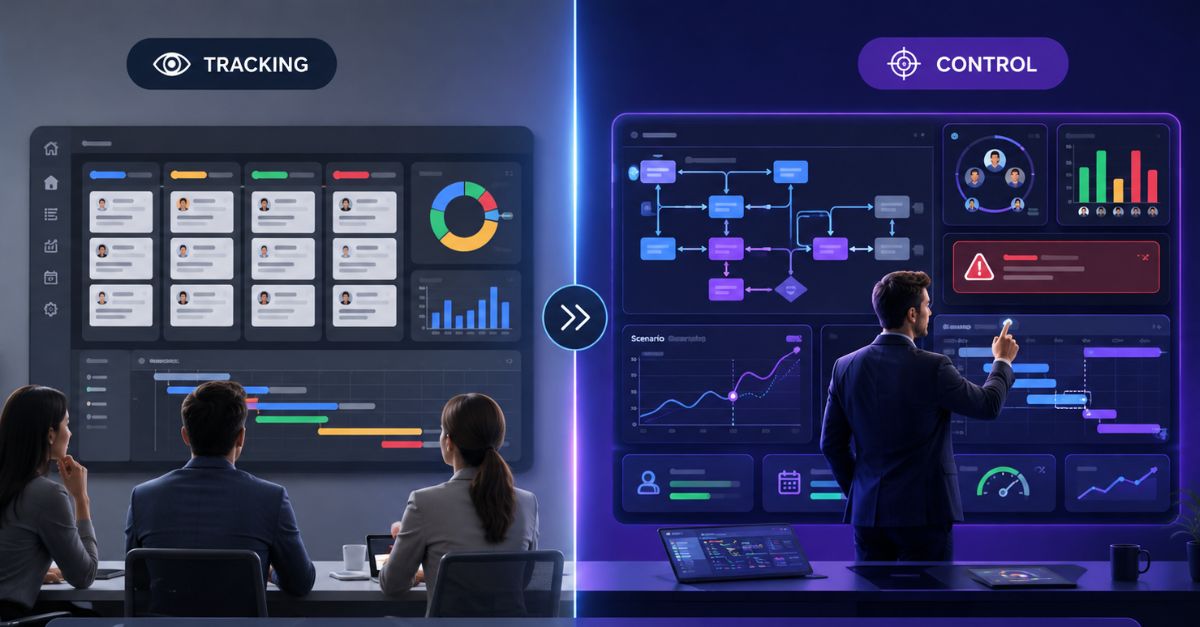
The projects that consistently deliver don't rely on lagging indicators alone. They track leading indicators: task completion velocity relative to plan, resource utilization trends, how much buffer the critical path actually has, how many dependencies are at risk of slipping. These signals exist in the project data. Most project management tools just don't surface them automatically, someone has to go looking, and by the time they look, it's often too late.
That's the difference between a status someone updates and a project health score the system calculates continuously: does the current pace of task completion match the dependencies it depends on, is resource allocation sustainable given actual velocity, does the critical path have enough buffer to absorb the delays already baked into the plan, is the delivery forecast trending in the right direction?
When health is calculated instead of guessed, three things change. You stop being surprised. Problems surface while they're still small enough to address instead of after they've compounded. You have better conversations, when health is slipping, you can show exactly what's driving it and what it would take to recover, instead of explaining how a green project suddenly needs two more weeks. And trust improves.
When status reflects reality consistently, clients and stakeholders develop real confidence in what they're being told. That confidence is hard to earn and easy to lose, and it disappears the first time a project reported as healthy misses a major milestone.
The Question Worth Asking
For any project in your portfolio right now: is the status reflecting what someone believes, or what the data shows?
If it's the former, you have green projects that may not actually be green. And at some point, one of them is going to miss a deadline in a way that feels like it came out of nowhere... but wasn't.
Project health should be something your process and platform calculates, not something your team guesses at. The difference shows in whether you're managing delivery or just reporting on it, which is exactly the shift Moovila is built around.
Learn more about how Moovila calculates real-time project health so teams can see risk before it becomes a problem.
Project Management