Sep 11, 2026
8 Questions to Ask Before You Pick an AI Project Management Platform
Not every AI-powered project management platform improves the way projects are planned and delivered. Use these eight questions to evaluate schedule automation, risk detection, resource capacity, integrations, critical path analysis, and the other capabilities that separate genuine project intelligence from surface-level AI features.

Your project manager sends the weekly status update: everything's green. Three days later, a client is on the phone asking why the migration that was supposed to wrap Friday is now two weeks out. Nobody flagged it, because nobody was tracking the dependency that quietly slipped underneath the parts everyone was watching.
That's the gap most "AI project management" platforms are supposed to close. But many simply add smarter-looking dashboards without improving the accuracy of the underlying project schedule.
Picking the right one means asking questions that go past the demo script. Here are the eight that reveal whether a platform actively improves your project schedules—or simply displays them.
The eight questions to ask when evaluating AI project management software:
- How does it create and manage task dependencies?
- Can it update schedules automatically when dates, dependencies, or resources change?
- What risk detection does it actually offer?
- How does it manage resource capacity?
- Does it support real critical path analysis?
- What integration options are available? How does data move between systems?
- Does it provide real-time visibility into project and portfolio health?
- What onboarding and support does it include?
Why these eight questions
IT and MSP project teams rarely see projects fail because of one major mistake. It’s usually the accumulation of missed dependencies, schedules that weren’t updated after a change, risks no one saw coming, and resources no one realized were double-booked. So that's what we built this list around:
- Dependency accuracy: can the platform track finish-to-start, start-to-start, and other relationship types without someone manually re-drawing the plan?
- Schedule automation: does it recalculate timelines when something changes, or does your team rebuild the plan by hand?
- Risk visibility: does it flag problems before they hit your delivery date, or after?
- Resource intelligence: can it match tasks to people based on skills, workload, and actual availability?
- Critical path clarity: can you see which tasks actually determine your finish date?
- Integration flexibility: does it talk to the PSA, CRM, and calendar tools you already run?
- Real-time data: does every view reflect a change the moment it happens?
These are the capabilities that matter. Below, we break down what a credible answer should include and explain how Moovila approaches each area, so you can see what these capabilities look like in practice.
1. How does it create and manage task dependencies?
Ask any vendor to actually demonstrate this; don't take the feature list at face value. A platform built for IT projects needs to support finish-to-start, start-to-start, finish-to-finish, and start-to-finish relationships, plus lead and lag time. Some tasks can kick off before their predecessor is done; others need a buffer after. Without that flexibility, your schedule looks clean and doesn't match how the work actually happens.
Moovila's dependency management goes a step further and checks the structural integrity of the plan itself, flagging dependencies, missing links, and other flaws that quietly corrupt your forecast before you ever see them.
2. Can it update schedules automatically when dates, dependencies, or resources change?
A schedule that has to be rebuilt by hand whenever a date, dependency, or resource assignment changes is already outdated by the time you finish rebuilding it. The platform should automatically calculate how each change affects downstream tasks and the final delivery date.
Moovila's Critical Path Engine recalculates every affected date the moment a change happens and proposes the new plan for you to accept in one click. PMI's research on schedule management points to realistic, current schedules as one of the strongest predictors of project success. Automation is what keeps a schedule realistic past week one.
3. What risk detection does it actually offer?
There's a real difference between a platform that flags risk continuously and one that only tells you what you already know, whenever someone remembers to run a report. Ask which one you're getting.
Moovila's RPAX engine runs in the background around the clock, watching over 20 risk factors across your whole portfolio: invalid dates, blocked tasks, overloaded resources, tasks drifting toward a missed milestone, and pairs every alert with guided remediation so you're not left guessing what to fix first.
4. How does it manage resource capacity?
None of the above matters if the platform is still handing work to someone who's already at 130%. Ask how it tracks availability, and ask specifically whether it prevents over-allocation or just reports it after the fact.
Moovila pulls calendar data, PSA tickets, and project assignments into one real-time capacity view, and Smart Schedule suggests the right person for a task based on skills and actual availability, not just whoever's next in the rotation. That's also what lets your team flag "I'm underwater" before a deadline slips instead of after.
5. Does it support real critical path analysis?
The critical path is the chain of tasks that actually determines your finish date. A delay anywhere else on the plan might not matter; a delay here always does. A lot of tools claim critical path support and mean a static diagram generated once at kickoff.
Ask whether the analysis updates as work progresses, and whether it accounts for resource constraints that change task duration, not just dependency order. Moovila calculates the critical path continuously, using the actual dependency graph, and shows the cascading impact of a delay across the rest of the timeline, not just the next task in line.
6. What integration options are available? How does data move between systems?
Your platform needs to talk to the tools your team is already using... PSA, CRM, calendar, time tracking. Ask specifically about bidirectional sync. A lot of "integrations" only pull data one direction, which just moves the manual reconciliation somewhere else instead of removing it.
Moovila's integrations keep resource availability, time entries, and client data in sync across systems, so nobody's re-entering the same information twice.
7. Does it provide real-time visibility into project and portfolio health?
If the dashboard is showing yesterday's numbers, you're making today's decisions on old information. Status should update the moment the work does, and so should the notifications. When a task goes at-risk or a dependency shifts, the people who need to know should hear it immediately, not at the next status meeting.
Moovila's dashboards run on live data, forecasts, budgets, risk scores, so your team sees current assignments, and your execs see portfolio health without waiting on a weekly write-up.
8. What onboarding and support does it include?
The best scheduling engine in the world is worth nothing if your team doesn't know how to use it, or, more importantly, how to get the most value from it
Because Moovila is a sophisticated platfrom, Moovila pairs onboarding with a dedicated customer success manager so adoption doesn't depend on a single training day that everyone half-remembers. Moovila’s onboarding is designed to help teams get acclimated to the platform while also strengthening the project management processes behind it.
Moovila’s onboarding is more like project management coaching than a typical implementation. Teams learn not only how to use the software, but how to apply project management best practices, build stronger processes, and get the most out of the platform’s capabilities.
The goal isn’t simply to get your team through training and call it done. It’s to help your team become more confident and establish processes that continue to deliver value long after onboarding is complete.
How AI is actually different from "automation"
Basic automation follows a rule: Task A finishes, Task B starts. AI goes further... it looks at patterns across your portfolio, predicts where things are headed, and tells you what to do about it before it's a problem. Moovila's AI coaching (we call it Carmen) doesn't stop at just flagging an issue; it explains why it matters and walks you through fixing it in the right order, and it gets sharper the more of your project data it sees.
Where dependency tracking breaks down at scale
Manual dependency tracking works fine on a ten-task project. It falls apart somewhere around task one hundred, spread across three teams. At that scale, accuracy depends on the system enforcing structural integrity and recalculating instantly, not on someone remembering which task feeds which.
That matters even more once multiple teams share deliverables. Without visibility into how a delay in one project ripples into another, coordination breaks down quietly, and nobody notices until a date is already missed.
What the right platform should deliver
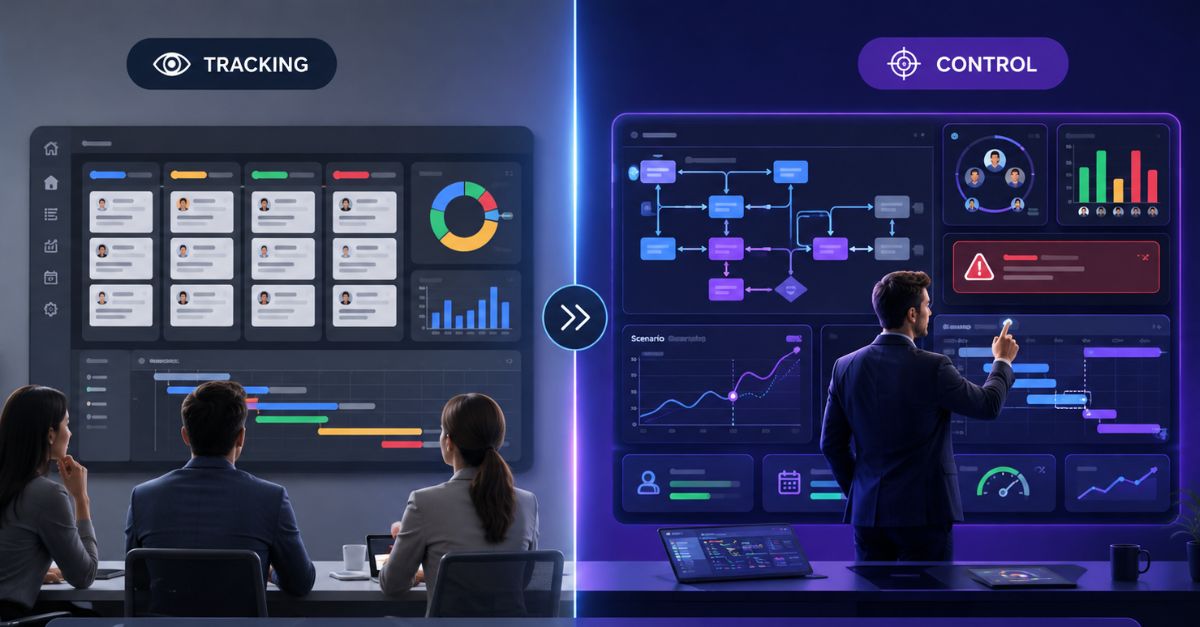
Most project management tools show you your data. Few actually understand it. A platform worth paying for should be recalculating dependencies, durations, and resource capacity continuously, not waiting for someone to ask it to, or do it manually.
If you want to see what that looks like against your own projects, book a demo today.
Project Management