
May 11, 2026
What Is Critical Path Management and Why Is It Essential for MSP Projects?
Not every task has the same impact on your deadline. Critical path management helps MSPs see which work matters most, where delays will hurt, and how to keep projects moving before small slips become expensive surprises.
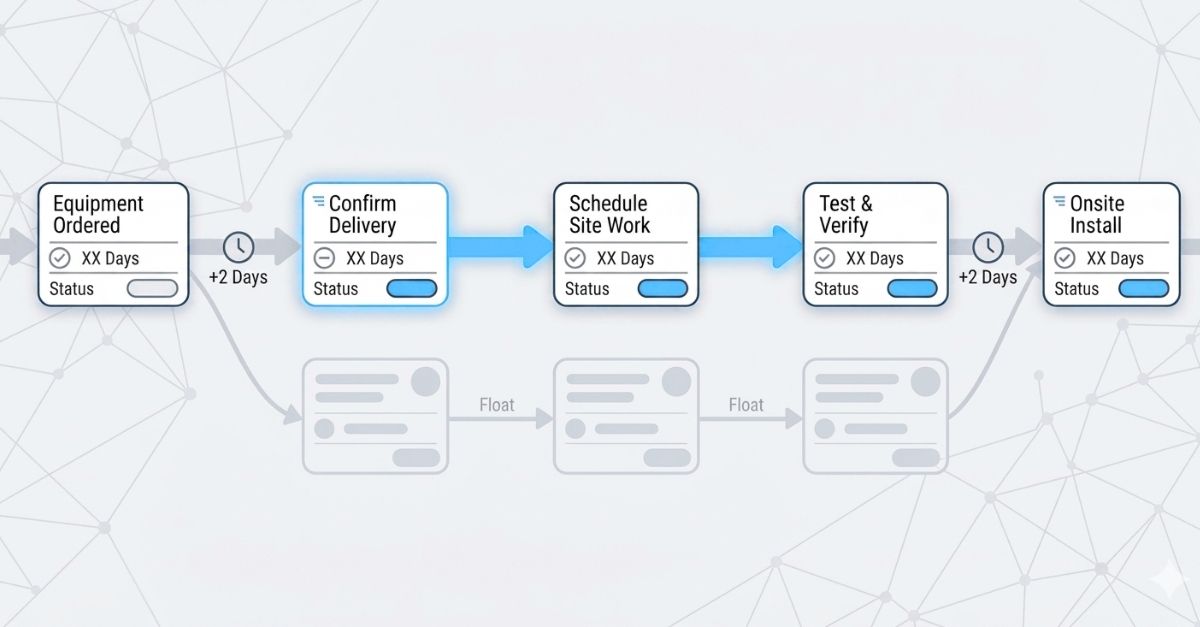
Your tier-2 engineer tells you the firewall config is "almost done." Two days later, you find out "almost done" meant 70% and the 30% remaining is what was blocking testing, which was blocking the cutover, which was supposed to happen Friday. The migration that was scheduled to wrap this week is now slipping into next month. Nobody saw it coming, because nobody was tracking the work that affected the entire timeline.
If that sounds familiar, you don't have a project tracking problem. You have a critical path problem.
What is a critical path?
A critical path is the longest sequence of dependent tasks in a project. It represents the work that determines the project’s earliest possible finish date. In a traditional project plan, tasks on the critical path have zero total float, meaning delays to those tasks delay the overall project. Tasks outside the critical path may have float, or room to slip, without immediately affecting the final deadline.
In plain English: the critical path is the work that controls your finish date. Everything else is supporting cast.
Most MSPs run projects as a flat list of tickets in a PSA. Every task looks equal in importance, every slip looks equally concerning, every status meeting reads like a list of things in progress. And when the whole project gets shoved into one overloaded “projicket,” the timeline becomes even harder to see. That's not a project plan. It's a to-do list with a deadline taped to the bottom.
The two questions a critical path lets you answer
A real critical path helps you answer two questions instantly:
- "If this task slips by a day, do we miss the deadline?"
- "Which task is most worth my senior engineer's time this week?"
If you can't answer either of those about your active projects without stopping to think and pull out a calculator, you don't have a critical path. You have a hopeful schedule, and a list of work people are doing in roughly the right order.
Why MSPs struggle to see the critical path
There's nothing lazy about an MSP without a critical path. Most of them inherited the problem.
PSAs were built for tickets, time, and billing… not for modeling task dependencies, durations, and float. So, when an MSP onboards a client or runs a migration, the project gets planned in someone's head, captured in a spreadsheet, and then drifts. The PSA tracks the tasks but doesn't know that task B can't start until task A is done, or that task C is waiting on a vendor.
The result is predictable: engineers work on what's loudest. Whoever's escalating, whatever's overdue, whichever client emailed most recently. None of that has anything to do with which work actually controls the project deadline.
The cost is real. A senior engineer spending Tuesday on a non-critical task while a critical-path task sits idle isn't just an inefficiency, it's a slip in waiting. Multiply that across a project portfolio and you've got one of the largest silent margin killers most MSPs don't see until quarter close.
What changes when you actually map out the critical path
When you have a real critical path in your project, four things get measurably easier:
- You can defend a deadline. Or push back on it early when you can see it's unrealistic. No more late surprises that nobody can explain.
- You can prioritize correctly. Your best engineers go to critical-path work. Everything else schedules around their availability. That alone is often the difference between a project that lands and one that drifts.
- Status conversations become useful. "We're 80% done" tells you nothing. "The critical path is on track and we have two days of float" tells you everything. So does "the critical path slipped by a day on Tuesday and we need a remediation by Thursday."
- You can run more projects in parallel without them crashing into each other. Resource conflicts become visible before they become slips, because you know exactly when your senior engineer's critical-path window opens up on each active project.
Why critical path management Isn’t optional
A critical path isn't a luxury. For any project with a real deadline and real margin pressure, which is to say, all of them, it's the difference between a plan and a wish.
Every project should have its own critical path. You might map it in a Gantt tool, have a project manager maintain it, use software that updates it automatically, or use a mix of all three. But you can’t run a serious MSP project portfolio without knowing which work controls the timeline in each active project.
How Moovila helps
Moovila builds and visualizes the critical path into your project plans automatically and recalculates it the moment anything changes. A task slips, a resource goes unavailable, a dependency moves, and the plan updates in real time so you can see exactly what's at risk. The RPAX score layers on top, scoring portfolio risk continuously so you know which projects need attention before they run late and drain your margins.
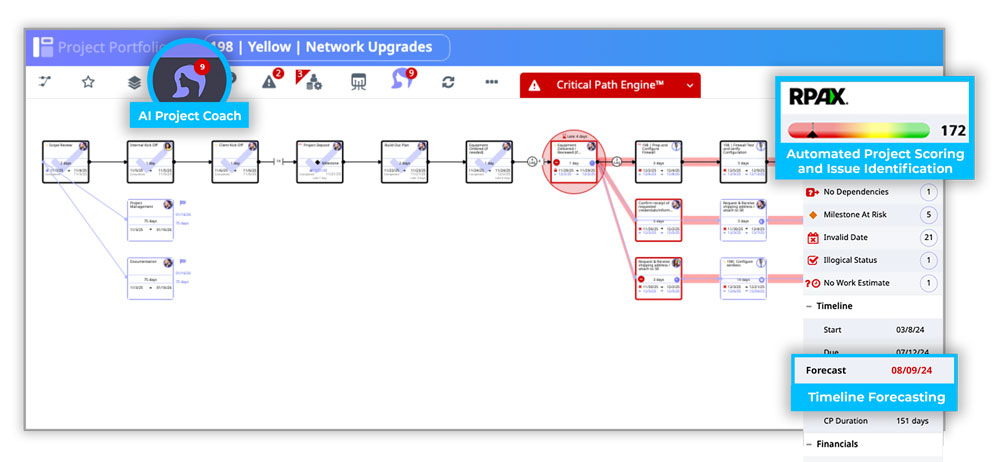
If you're curious what your projects' critical paths actually look like and what you've been missing, you can book a demo here.
Project Management
IT Services